
Year: 2021
Family, Friendships, and Funerals
I’m closing the door gently on 2021. No slamming, or sighs of relief. I don’t want to tempt any gremlins on the other side.
For those of us who complain that the years pass by quicker than ever, the four months’ lockdown in Auckland from August this year had Christmas barrel towards us with extra speed. We assessed life differently, and came to a heightened appreciation of family and friends.
I would have let 2021 slip away quietly, not made this post on the last day of the year, had it not been for wanting to formally farewell three dear people.
This time last year Joanna née Adamek Kalinowska and Stefania née Pracz Boyle were both becoming more frail. Pani Joanna died on 17 January this year, and Pani Stefa two weeks later. I met them both in 2018, and both were willing to share their stories for this website. They did not know each other, but they were both born in Poland, and in 1940—five months after the Russian invasion of eastern Poland—were both rounded up with their families by armed Soviet soldiers—Pani Joanna aged 11 and Pani Stefa nine—and taken on cattle trains to Soviet forced-labour facilities in northern Russia.
After the Polish army helped Poles escape the USSR in 1942, Pani Joanna ended up with nearly 20,000 other Poles in one of the Polish refugee camps scattered along eastern and southern Africa. England accepted them as refugees in 1948. Twenty-five years later, she and her husband, Polish army veteran Tadeusz, arrived in Auckland with their four children.
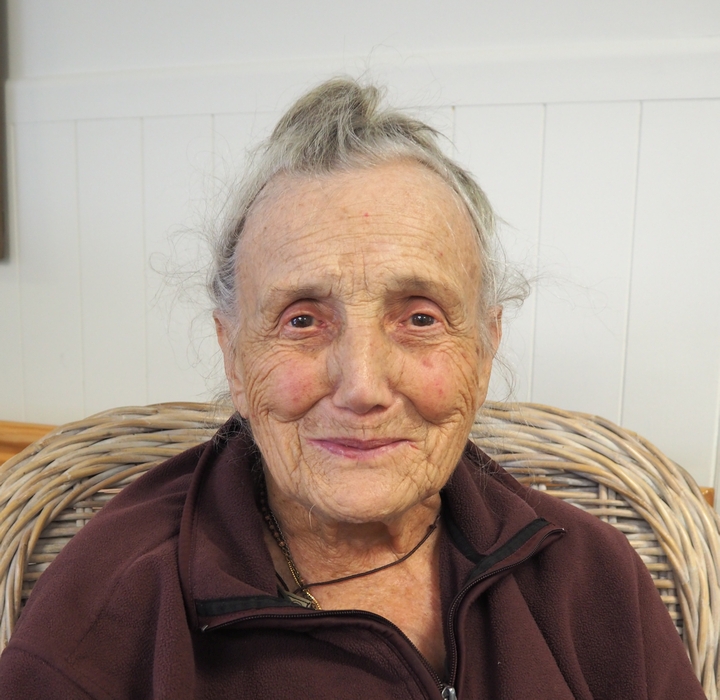
Covid put an end to easy access to Pani Joanna, who lived in a retirement home, but I made a few notes the last time we had a long phone conversation, when she again reflected on her life:
“For the first few years, when we were taken to Russia, I cried continuously. I wanted to go back to Poland. When I grew up, I realised there was no point in crying. You have to accept what you are facing and make the best of it.
“I lost my patriotic feeling towards Poland, but you can’t take your nationality out of your soul. Your country is like a mother. You may not always like her, and she might not always like you, but when you are born in a certain country, you will have patriotic feelings towards her.
“These days, as long as I have a roof over my head, a bed to sleep in, something to eat, what else can I demand? You have to take in life what comes to you because it is not often that you can make your own decisions.”
_______________
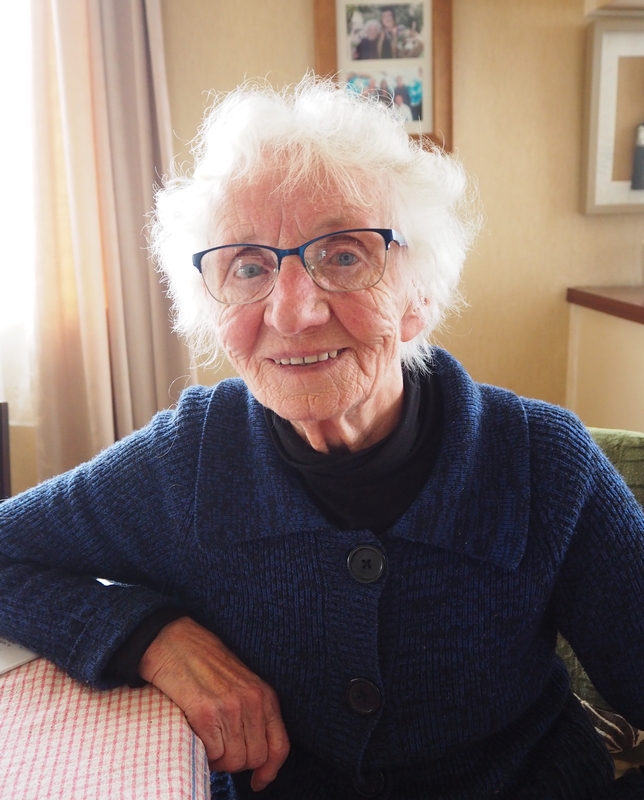
Pani Stefa, with her sister Eugenia, was among the 733 Polish children whom the New Zealand government invited, with their caregivers, to wait out the war in peaceful security. They arrived in Wellington in November 1944 and, after it became clear that allied Poland had lost her land to the Soviet regime, Prime Minister Peter Fraser extended that invitation.
The sisters had become separated from their parents and older stepsisters in Kazakhstan in 1942, after Stalin released the Poles from his forced-labour facilities. The Pracz family had travelled south to find the Polish army, but circumstances became so dire without food, water, or shelter that their mother put them into an orphanage. Years later they found out that their parents had died within days of each other in Kazakhstan, but that their stepsisters survived, and lived in Poland.
Pani Stefa married Graham Boyle in Auckland in 1953, and had three children. At her funeral, we heard about her feisty character, her infectious sense of humour and the stubbornness that helped her overcome her experiences in the USSR in WW2.
_______________
Richard Wach died suddenly on 7 May. I thought I was one of his favourite non-family members, because he’d phone saying it was “Wujek Rysiek,” then chuckle. He used to play with my uncles Rysiek and Janusz at the Polish refugee camp in Tengeru, in then Tanganika, now Tanzania, and remained friends with them when they all moved to England long after WW2 had ended for others. I found this out when we met at a function at the Auckland Polish Association, when he took pity on a newcomer standing alone and asked me my maiden name.
I found out at his funeral that I wasn’t the only one he was a ‘wujek’ to. He befriended and mentored many in his community, and had a special affinity for new immigrants from any country. He knew what it was like to move and start again.
He was a toddler when the Soviets removed him and his family from eastern Poland in February 1940. He last saw his grandmother when she left the cattle train to look for food when it stopped on its way towards what he called the Archangielsk forests, and it left the station without her. He knew that his grandfather died of starvation at the forced-labour facility deep in those forests, and that his parents went without food to feed him and his older brother, Stanisław. His father managed to find the Polish army in Uzbekistan, and enlisted, but died soon after. His mother accompanied her sons to Africa, but died of malaria in Tengeru in 1943.
In 1948, the brothers Wach, then nine and 12, sailed on the Carnarvon Castle, with my uncles and paternal babcia, to Southampton and a fresh start in England, where Pan Rysiek met his wife, Maureen. They immigrated to Canada in 1967 and, with three children, to Auckland in 1981.
This year we lost three beautiful Poles: a motherly angel, an inspiration, and an anchor.
So not a good riddance to 2021, but a farewell.
—Basia Scrivens
31 December 2021
_______________
Joanna Kalinowska’s story is available at https://polishhistorynewzealand.org/joanna-adamek-kalinowska/
_______________
If you would like to comment on this post, or any other story, please email editor@polishhistorynewzealand.org/
Polish kitchens
My mother was the world’s second-worst cook. My husband and I confirmed it when we let her know we were on the road, six to seven hours from her place, and she said, “Good, I’ll get the pork chops in the oven now.” That dinner, with her favourite out-of-the-packet frozen diced mixed veg, lived up to our expectations.
She lost the worst cook title to our son’s partner’s grandmother, who made every main meal the same way: put a pot on the stove, add water and ingredients. Seeds in the butternut? All in. Trimming any meat? What?
My babcia, my mother’s mother-in-law, was the opposite. When I was little, she ran the kitchen at Fawley Court, Henley on Thames, the Marian Fathers’ boarding school for Polish boys, set in idyllic buildings and grounds on the Thames as it glides through Oxfordshire. Her baking was supreme, and she taught me in ways I sometimes did not appreciate when she was at home and away from her kitchen appliances, and made me use the back of a wooden spoon to cream castor sugar with either butter or egg yolks.
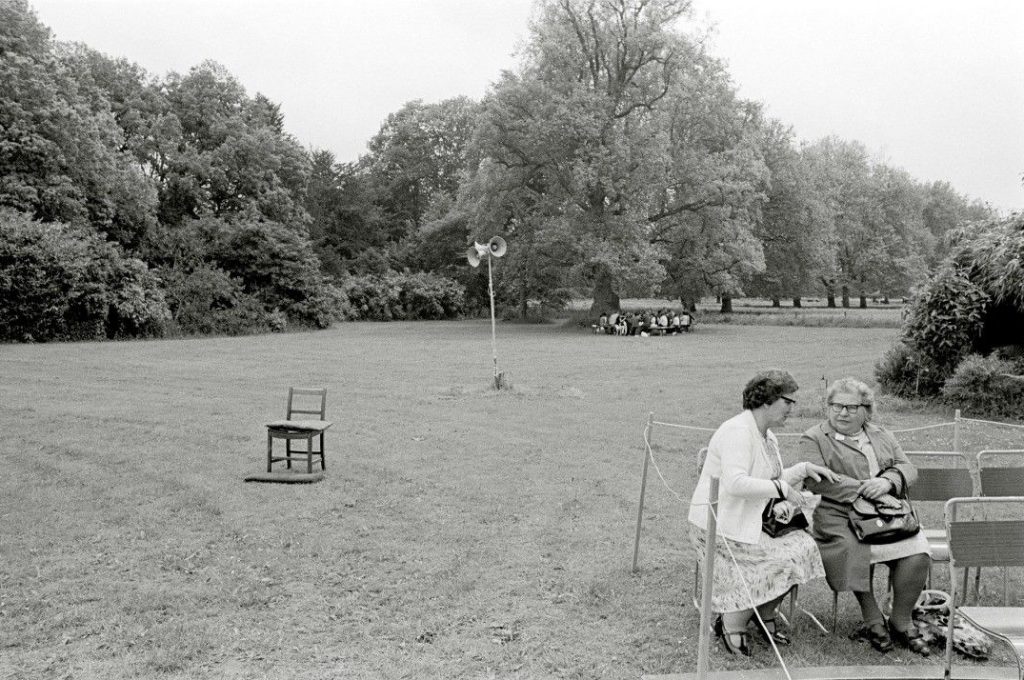
Babcia taught me to bake by muttering hints (Never use all the sugar a recipe tells you to; never take your eyes off the stove when you are making masa for torte; add a dash of self-raising flour to ground almonds…) and by allowing me to absorb the feel of a bake. Measurements were by cup or glass.
I was proud to have baked my first cake without babcia’s supervision, aged eight, and it did not occur to me that my mother did not bake. I followed babcia’s recipes by memory. She did not write them down – that I know of – but after I left England and babcia, my memory faded.
The last time my mother saw babcia in England, she insisted the old lady give her her sponge recipe “or it will be gone forever” so now I have babcia’s official recipe for that in my mother’s handwriting.
There is something about people who share recipes. Few of them work out as they say. Maybe I read too literally, but there always seems to be something left hanging, too loose, too easily misinterpreted, like: how “cool” is “cool?”
I don’t think I will ever find the chemical wizardry that was babcia’s famous honey-cake, and am tired of trying, so decided to create something simpler this Christmas: pierniczki, Polish gingerbread biscuits.
My old-fashioned Polish cookbook was too loose in its description of “honey-cake spices,” so I trawled the internet for inspiration. It was the first of three versions that I made this week. Christmas reminds me of babcia – and her glorious torte – and in her honour, here is my version of pierniczki. I am not sure whether she would have been quite so liberal with the spices, but I have the feeling that her angel on my shoulder might nod an okay, possibly admitting that her hours babysitting me were not wasted:
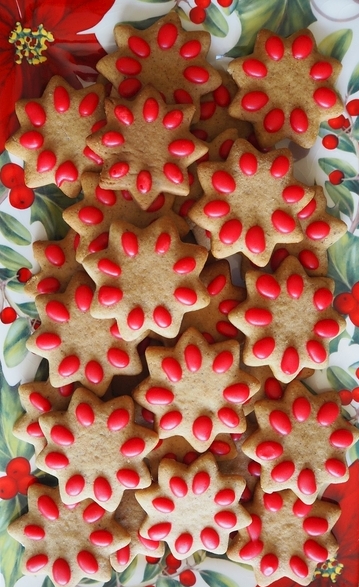
PIERNICZKI
- Prepare the spices. Most recipes use less than I do, but I like the kick. Make them to your own taste. If you use ground, buy them fresh. Apart from ginger, I like to grind – or in the case of nutmeg, grate – my own. I don’t believe ground husks add anything to flavour, so I open the cardamom pods and use just the seeds, and sieve the husks from the coriander.
– 4 teaspoons ground cinnamon
– 4 teaspoons ready ground ginger
– 2 teaspoons ground nutmeg
– 2 teaspoons ground cloves
– 2 teaspoons ground coriander (possibly odd, but it works)
– 3 teaspoons ground cardamom
A teaspoon of ground black pepper adds a zing, but may be a step too far for some. - Other ingredients:
– 115g unsalted butter (the equivalent of a Polish “stick”)
– 250g honey (try to use a good, creamed version)
– Two large eggs at room temperature
– Two sets of castor sugar: 125g for the main mix and 60g for the pre-mix
– 3 cups of flour: after experimenting with grammes, I found a cup measure that seems to work. I tap it to make sure that the flour is sitting well inside.
– 2 teaspoons baking powder. - Method:
– Combine the spices, butter, and honey in a pan and cook gently for a few minutes. (I chose this bit out of one old-fashioned recipe because it reminded me of savoury recipes using spices that start with “heat spices in a frying pan.”)
– Set aside.
– In another small pan – which you have prepared by re-cleaning an already clean pan with boiling water, and wiping with a clean cloth – let the 60g sugar dissolve into caramel on a medium-low heat. (Do not stir, do not add anything, do not touch it. You may jiggle the pot slightly, but if the pot is clean, and no foreign body has touched the sugar, it should dissolve.)
– As soon as the caramel is done, add the still-warm honey mixture to it, mixing quickly as the caramel tends to harden quickly.
– Allow to cool. (Don’t be distracted for too long. Here, “cool” is more “lukewarm.”)
– Beat the egg whites – they need to be quite stiff – and set aside.
– Beat the egg yolks with the 125g sugar until creamy. (Preferably not with a wooden spoon, or your butter-honey-spice-caramel combination will truly cool.)
– Add the honey mixture to the creamed eggs.
– Gradually incorporate the sifted flour and baking powder until it gets too stiff to handle easily.
– From then, alternate between adding the egg whites and the rest of the flour. (You may need a dash more flour. Here, you need to use your initiative.)
– Transfer to a ceramic pot that you can keep, covered, in the fridge for five to seven days.
– Roll out cool dough to about 5mm. Cut out shapes, place on baking paper and bake in a pre-heated (200 deg) oven for seven to 10 minutes. Be careful. Do not overbake.
– When cool, decorate with a melted chocolate glaze; or one made from icing sugar and lemon; or icing sugar, water, and almond extract. Decoration depends on who you have in the kitchen to help you.

Enjoy the Christmas baking!
—Basia Scrivens
29 November 2021
_______________
If you would like to comment on this post, or any other story, please email editor@polishhistorynewzealand.org.
Documentary photographer Czesław Siegieda took the Fawley Court photograph. His website is www.czeslawsiegieda.co.uk and his Instagram address is Instagram.com/czeslawsiegieda.
Scars Left Behind
The rust stains in the low pebble-rendered walls drew me to cross the road. I saw that they were caused by the remains of shells, and that the heavy railings set into those walls were pockmarked too.
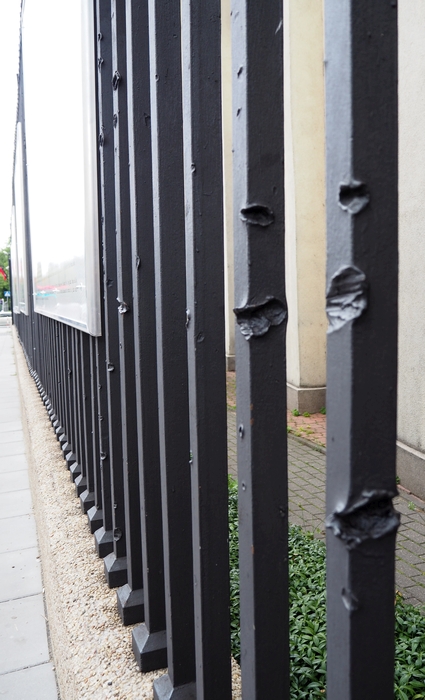
I followed the railing-wall around the corner and found the cause: The building had been integral in the 63-day Warsaw Uprising in 1944.
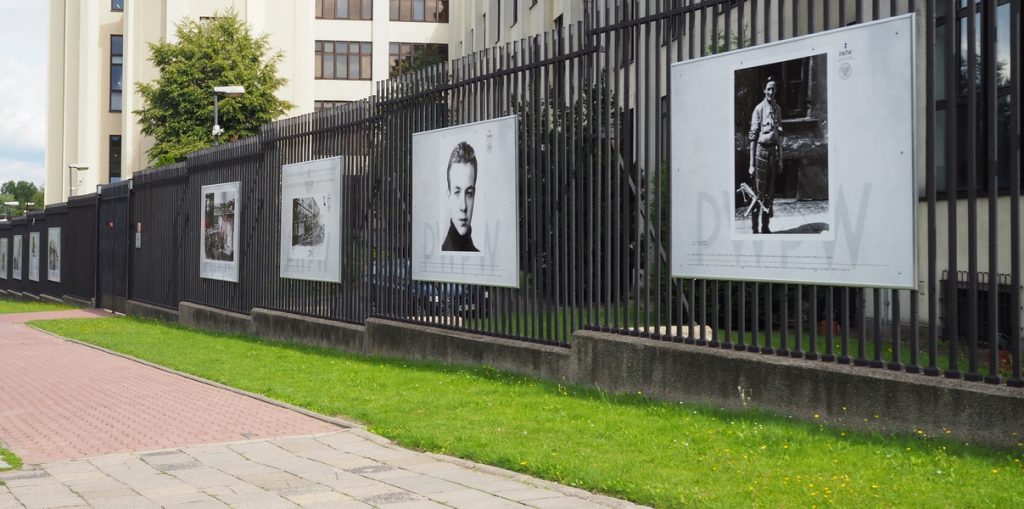
It belonged, and still does, to the Polska Wytwórnia Papierów Wartościowych, the Polish Security Printing Works, details I found out thanks to a series of several giant posters mounted along the railing on Zakroczymska Street, and more around the corner on Sanguszka.
I did not set out with any specific plan that day, my second in the city. I took my street map and meandered north from where I was staying just outside the Stare Miasto, the Old Town. Earlier, I had spent time at another Warsaw Uprising poster exhibition, mounted on much smaller railings outside the Roman Catholic church on the New Town market square, barely 400 metres away.
Those scars of battle gave reality to the PWPW poster exhibition. I was glad that the railings still stood, defiant and as obstinate as any Pole. I wanted to record them and their story.
I hadn’t been there long when a man, who I assumed was a security guard, appeared on the other side of the railings and asked what I was doing.
I’m a visitor, I told him in my imperfect tongue. I am Polish. I am interested in all this. It is my history. He seemed satisfied.
I am glad that I was able to turn the corner into Sanguszka and spend more time with the posters before another security guard approached me. Remove yourself, he said, not interested in my reason for being there or taking photographs of the posters. Then, I did not immediately link the PWPW logo on the posters with the building, but even if I had managed to mount an argument—Is an outdoor exhibition not meant to encourage people to stop, read, and take photographs?—I allowed myself to be bullied away. He reminded me too much of the 1970s South African security police, and I was aware of being on my own.
I was disappointed and frustrated: There were several posters I had not had a chance to get to, and I was interested in the next one. Surely he was too young to be in a commanding position. I crossed the road to the park, continued to find and photograph memorials, and made my way back to my accommodation along the river.
_______________
The candid recollections of a 12-year-old who became a theatre nurse’s assistant during the uprising, opened the way for a new menu in our War Immigrants page. The story is called Sixty-three Days and appears under 1944 Warsaw Uprising.
It reminded me of the many plaques and memorials to the Warsaw Uprising in that city, and specifically of the railings I saw on 14 August 2016.
Polish insurgents who worked at the printing works, captured them from the Germans on 2 August 1944 and, with other AK (Armia Krajowa) units, held them until 28 August. German forces supported by tanks and airplanes bombarded the buildings and pushed the insurgents to lower and lower levels. Dr Hanna Petrynowska, the PWPW’s factory doctor, had set up a field hospital in the underground shelter. Some of the surviving insurgents managed to escape, but Dr Petrynowska and her nurses refused to leave the wounded.
According to the Warsaw Uprising Museum, Dr Petrynowska was performing a surgical procedure when the Germans finally re-took the building. She told the German soldier that she would not withdraw until she had finished. He shot her dead. The remaining nurses and wounded died after Germans threw grenades into the hospital bunker.
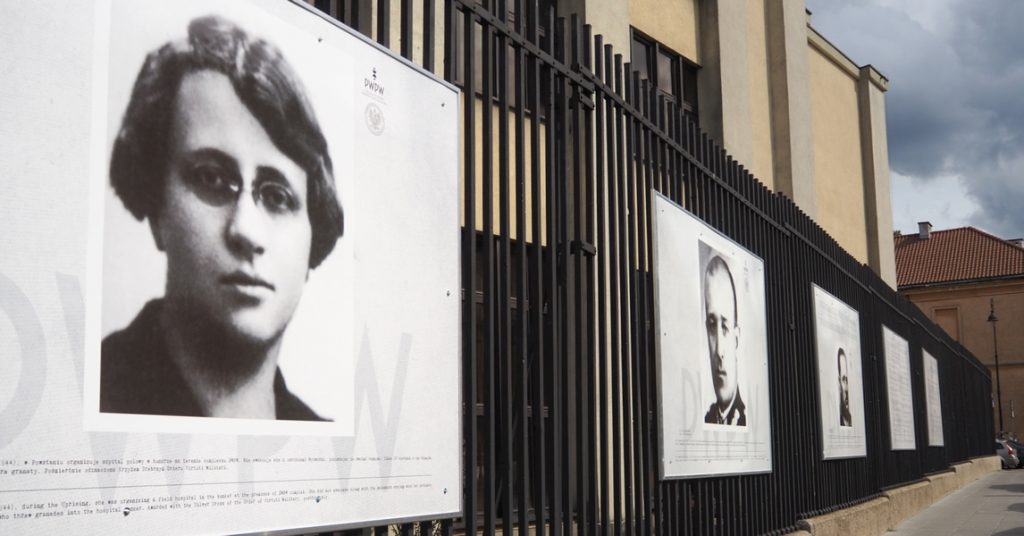
I do not know whether the PWPW commemorates its former employees every August. I do know that I was impressed by the number of Polish and Varsovian flags I saw flying from city lampposts and all sorts of buildings.
As I walked through the castle gardens on my way back to the apartment, I was stopped by the noise and by-passes of several military jets: the Polish Air Force rehearsing for the Polish Armed Forces Day parade the next day.
I had stepped into the annual commemoration of the Miracle on the Vistula, that day on 15 August 1920 when Poles repelled the Soviets in the Battle for Warsaw, also known as the 18th Decisive Battle of the World.
—Barbara Scrivens
29 October 2021
_______________
Our full Warsaw Uprising story is available at: https://polishhistorynewzealand.org/sixty-three-days/
Information on Juliusz Kulesza from: http://sunday.niedziela.pl/artykul.php?dz=z_historii&id_art=00024
_______________
If you would like to comment on this post, or any other story, please email editor@polishhistorynewzealand.org.
To Be Believed
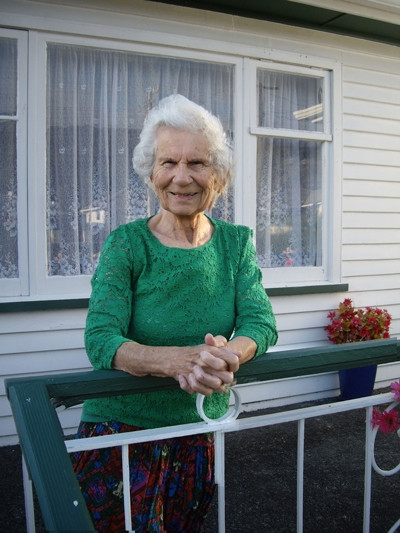
Stasia Kennedy was enjoying her usual cup of tea and a chat after Sunday Mass when the conversation at her table turned to a documentary that had aired on television the night before.
Those were the days of captive audiences watching few channels, so most people at her table had seen the same programme, about the Polish children who had lived in Pahiatua during WW2.
To some New Zealanders, decades after the war, their story seemed incredible. Soviet soldiers rounding up families at gunpoint and in the early hours, bundling them onto cattle trains, delivering them into the far reaches of the USSR, and making them part of a food for labour regime, must have seemed the world away that it was.
The 733 Polish children in the documentary escaped with the Polish army to then-Persia, and arrived in New Zealand with their 105 caregivers.
The consensus at Stasia’s table was one of scepticism. When one woman said, “I can’t believe it… this can’t be true, nobody can be that cruel,” Stasia had to correct her:
“I said, ‘1944, first of November.’ I said, ‘I was one of Pahiatua children.’
“And she said, ‘But you never talk about it.’
“And I don’t. I don’t talk about it because people don’t believe me. They say, ‘You’re making it up, Stasia.’
“Why would I make it up, something like that?
“Sometimes I lie in bed and think about it, all the things that I went through and how I survived. I can’t believe it myself but still, I survived. I was meant to survive. I don’t talk about it, except to my brother, only to ask him a few questions. He said, ‘What you remember, Stasia, everything’s true.’”
_______________
Documentaries like the one New Zealanders saw that night, and films like A Forgotten Odyssey brought life to the hundreds of testimonies that researchers like Zoe Zajdlerowa took down at the behest of Polish Prime Minister General Władysław Sikorski.
General Sikorski’s government was keen to find out how Poles felt after escaping Stalin’s forced-labour facilities; what had been their experiences in those facilities, run by Stalin’s Secret Police, the NKVD, in northern Russia and Siberia; how they survived the kolkhozes of Kazakhstan and Uzbekistan; and how they managed to leave.
From the time Soviet Russia invaded Poland on 17 September 1939, to the time Hitler turned on his ally on 21 June 1941, the Soviets managed to extract an estimated 1.7-million Poles from eastern Poland into the USSR. My paternal grandfather, Stanisław Nieścior, in his deposition for the Polish army wrote, wrote:
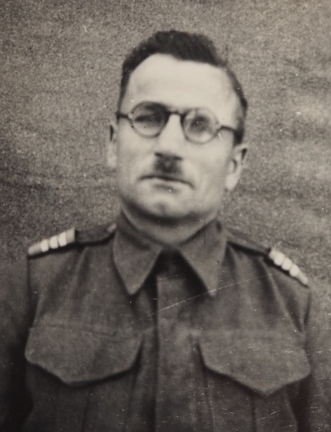
“We were locked in a starvation prison. There was a lack of manufactured goods, clothes, food, and fat… We were not expected to leave. Information about Poland, none. We were repeatedly told to forget Poland, that we were here forever…
“Punishment for being late to work, first time, reduction of wages by 25–30 percent for five to six months, second time, imprisonment. Relief from work could only be obtained with confirmation of a high fever. Lack of appropriate medication… Frequent fatal accidents… The gamekeeper Czerski lost two children, two and 10, from exhaustion.”
Hitler was not expected to cross the Soviet Russian-Nazi German border that the two powers concocted to divide Poland, but he did. The Poles were not expected to leave the facilities, but they did—after Hitler’s drive towards Moscow compelled Stalin to release the Poles, whom he planned to use to fight the Germans in Russia.
Some NKVD commanders in charge of the forced-labour facilities did not want to lose their labour. The commander at Tiesowaja, which held my grandfather, grandmother and three of their sons, told my grandfather, who could speak Russian, that there was a “lack of release destination documents.” They left anyway, on 12 September 1941. It took them almost five months to get to Tashkent in Uzbekistan. I know, because Stanisław Nieścior enlisted in the Polish army in Czokpak on 6 February 1942.
He wrote briefly about his and others’ experiences in Tiesowaja, and would have had some inkling of the numbers of Polish civilians in similar situations, but I wonder whether any of the survivors would have known what a small group they belonged to.
_______________
Total numbers of Poles taken against their will to the USSR between 1939 and 1941 vary, depending on the source: Soviet authorities apparently admitted to holding only 387,932 Poles during that time. Other calculations reach 2,636,000. I have taken the research of producer of the film A Forgotten Odyssey, the late Jagna Wright, as one of the most reliable.
She stuck at 1,692,000, made up from: prisoners of war from the 1939 campaign, officers who were imprisoned in western Russia and who were murdered by the NKVD in April and May 1940; civilians sent to forced-labour facilities; those condemned to prison elsewhere; and those incorporated into the Red Army.
General Władysław Anders, who organised the Polish army’s formation in the USSR, became worried when hundreds of officers he knew had been captured by the Soviets, did not enlist. In a chapter he called Those We Left Behind, he faced the fact that only 115,000 military and civilian Poles left the USSR with the Polish army in 1942. (A few more continued to escape through Ashgabad over the treacherous Kopet Dag mountains.)
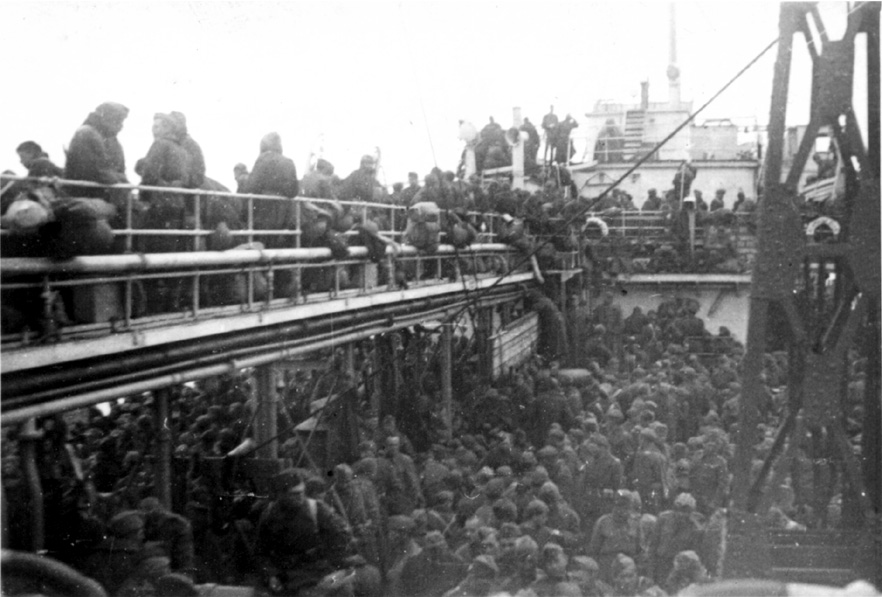
At best, fewer than 10 percent of the Poles removed to the USSR from 1939 to 1941, managed to leave.
Stasia née Błażków Kennedy was nine in 1942. Her mother and two sisters died of typhus in Uzbekistan. The Polish army accepted her brothers, Władysław and Bronisław, but not her frail 62-year-old father, Michał, who guided his daughter towards freedom, and died once cargo vessel that took them from Krasnovodsk (now Turkmenbashi) docked in the then-Persian port of Pahlevi (now Bandar-e Anzali).
She learnt too early what it took to survive, and to keep quiet about her experiences.
“It’s not their fault I went through the war. What do I have to be nasty for? Why do I have to talk about it? I tell myself, ‘Just forget about it.’
“But I don’t forget. I don’t forget. To the day I die, I won’t forget.”
—Barbara Scrivens
30 September 2021
_______________
Stasia Błażków Kennedy died on 20 April 2017. Her story is available at: https://polishhistorynewzealand.org/stasia-blazkow-kennedy/
Władysław Błażków died on 8 May 2019. His story is available at: https://polishhistorynewzealand.org/wladyslaw-blazkow-2/
General Władysław Anders’ book, An Army in Exile, was printed by The Battery Press Inc, Nashville, Tennessee, in 2004.
_______________
If you would like to comment on this post, or any other story, please email editor@polishhistorynewzealand.org.
A Nod to Old Warsaw
There is something about milestones in one’s life that put a perspective on what one considers important.
By 2009, although I had lived in three countries, on opposite hemispheres and sides of the world, I had never set foot in continental Europe. Five days in Poland to see maternal family were not enough then, and they made me yearn for more.
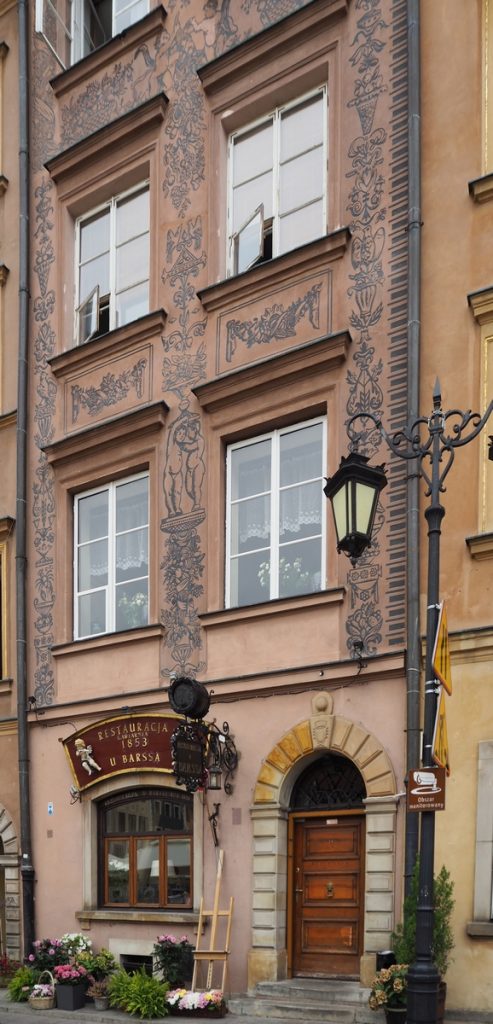
In August 2016 I marked my 60th birthday with three weeks in Poland, two on my own in Warsaw. As far as I know, my family has no connection with that city, but it drew me and I wanted to absorb its Polishness. No English-speaking husband. No children. No distractions besides the place.
I had booked an apartment on the edge of the Stare Miasto, the Old Town, on Podwale, overlooking the Barbican, part of its 16th century-defence wall. I love old architecture, and the address suited me.
I had to pick up the key, and caught a taxi from the airport to the office in Muranów. They gave me the key and address, and asked if they could call me a taxi to get to the apartment.
I decided I could walk the kilometre and a half. I needed to get my bearings, and wanted to investigate the grocery shops. How hard could it be rolling a suitcase and carrying hand luggage in midsummer, along unfamiliar streets? (If I had known about the cobbled pavements, I would have done my recce without the baggage.)
After a good hour, completely lost, I joined a crowd of tourists on Freta Street being told that the restaurant opposite was one of the most famous in the area. It had the best food, but the customers had to behave, or the owner would yell at them or throw them out. When the tourists moved on, I asked the speaker for directions: Podwale was around the corner.
The building used to be a convalescent hospital. The first evening started a ritual—I sat in the deep window-seat and watched the tourists go through the Barbican gates as the sounds of various violinists, choirs, and the regular clip-clopping of horse-drawn carriages drifted towards me.
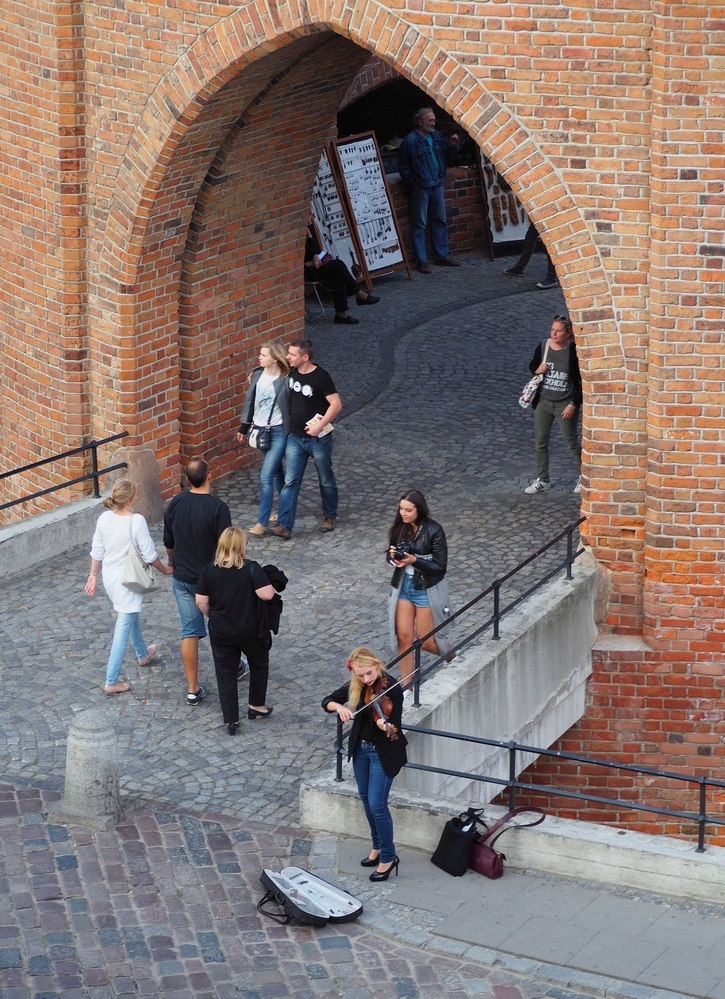
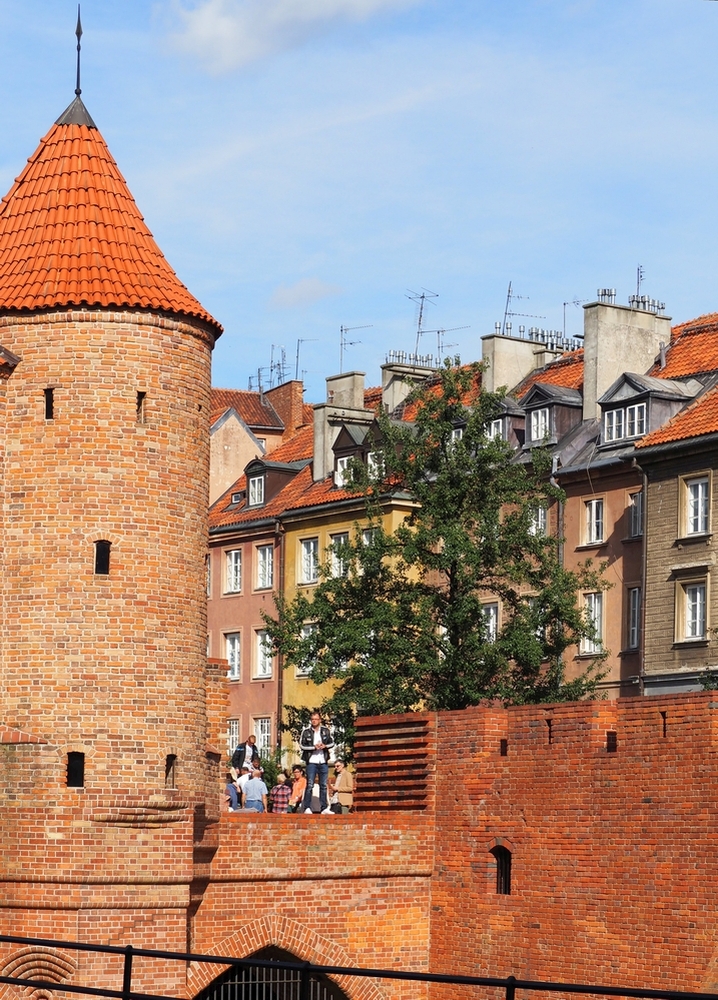
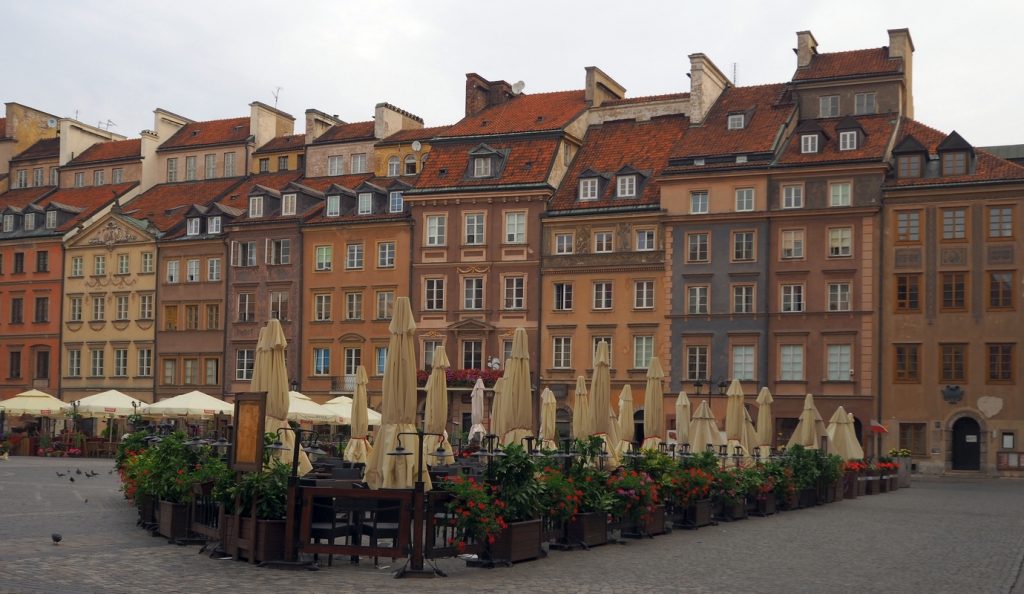
Within an hour from seven the first morning, I had taken more than 60 photographs around the Stare Miasto’s market square. I kept thinking about a friend’s story of his trip to Poland in the 1980s. When researching a caption for it, I found out that residents who had survived WW2, came back not quite being able to pinpoint what was different—it had been rebuilt in the likeness of a Bernardo Bellotto painting rather than as it was before the Nazis bombed it.
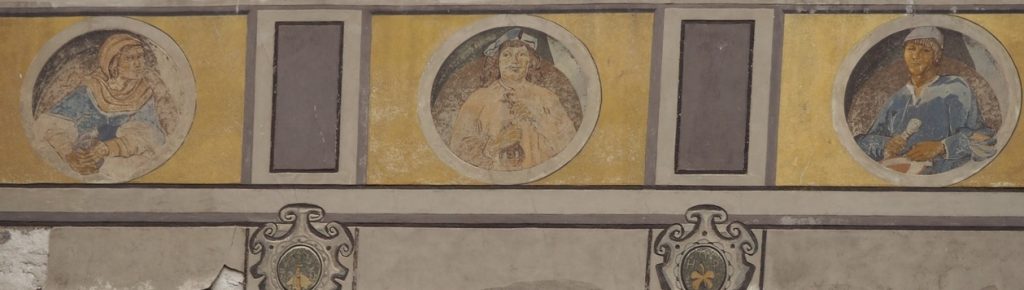
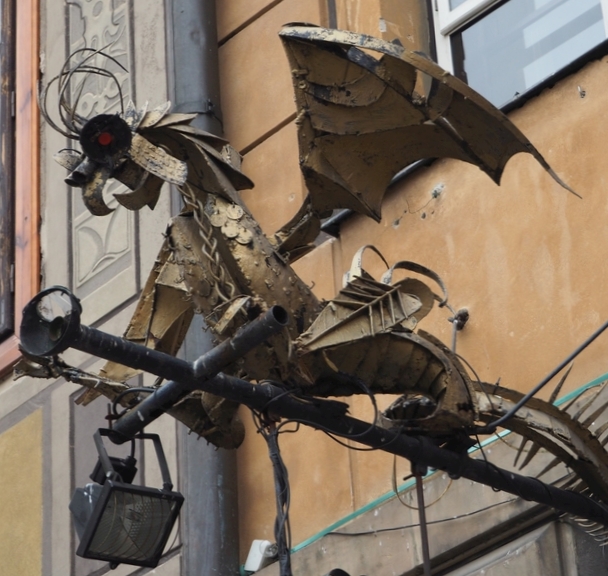
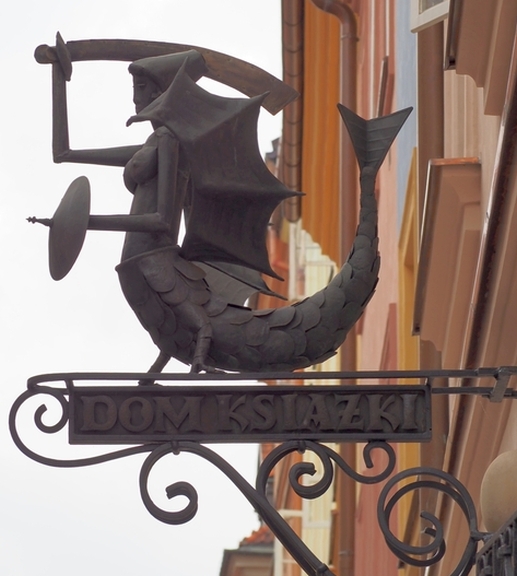
The sub-standard post-war Soviet materials did not last, and there are huge differences between my 2016 photographs and his 1980s ones. Restoration continues. I loved the painted embroidery on the walls, the facade embellishments, and the intricate, quirky metalwork that sat on light fittings and shop signs.
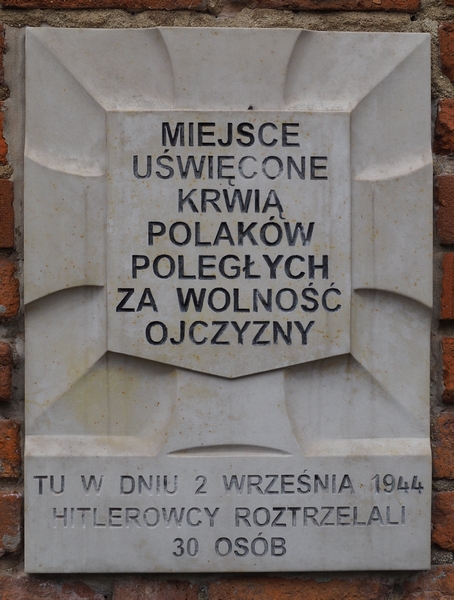
The first afternoon I turned right instead of left through the Barbican, noticed a plain cement plaque on a wall, and stopped short. On that spot the Nazis murdered 30 Poles—the same day my maternal grandfather, a bombardier in an anti-tank unit in the 1st Polish Armoured Division, was killed in action in northern France.
That was the first of many plaques and memorials I found and photograph as I walked around the Stare Miasto and beyond. Memorials of WW2 heroes touched me more than the overblown statues of kings or soldiers gone centuries ago.
I loved the way adults with children on their school holidays told them their history. As I waited to cross a street, I lingered to listen to a babcia telling her grandson about King Zygmunt on top of the huge column overlooking the Castle Square and beyond.
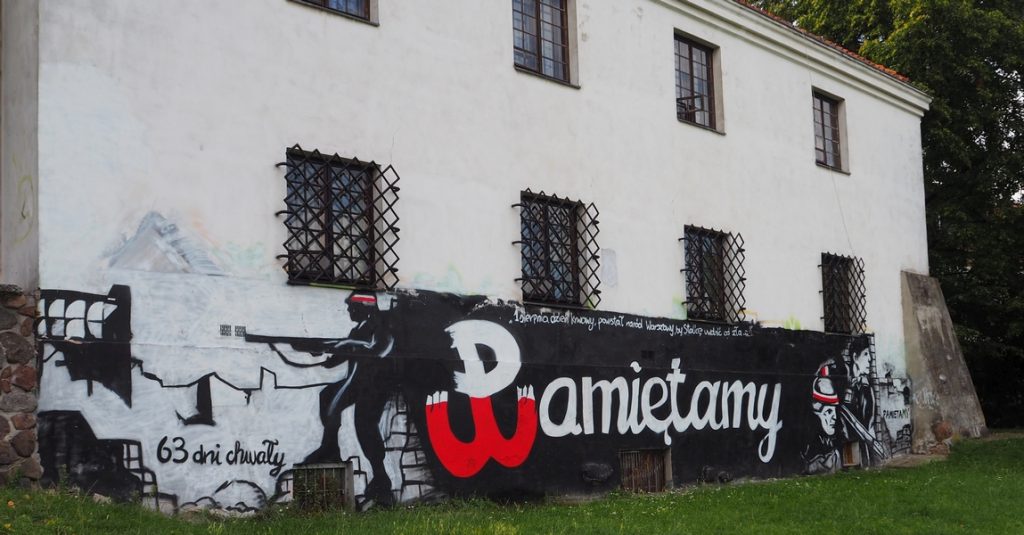
Sometimes, there were strange juxtapositions between the beautiful and the blunt. Barely 100 metres from an elegant statue of Marie Skłodoska Curie on the Kościelna, was this memorial to the AK, the Armia Krajowa, or resistance movement, active from 1942 to 1945. For 63 days from 1 August 1944, in what became known as the Warsaw Uprising, the AK held German troops back from the Stare Miasto and surrounds. As the photograph below says, we remember.
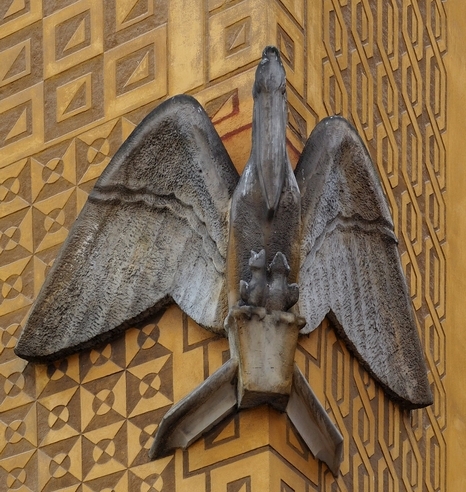
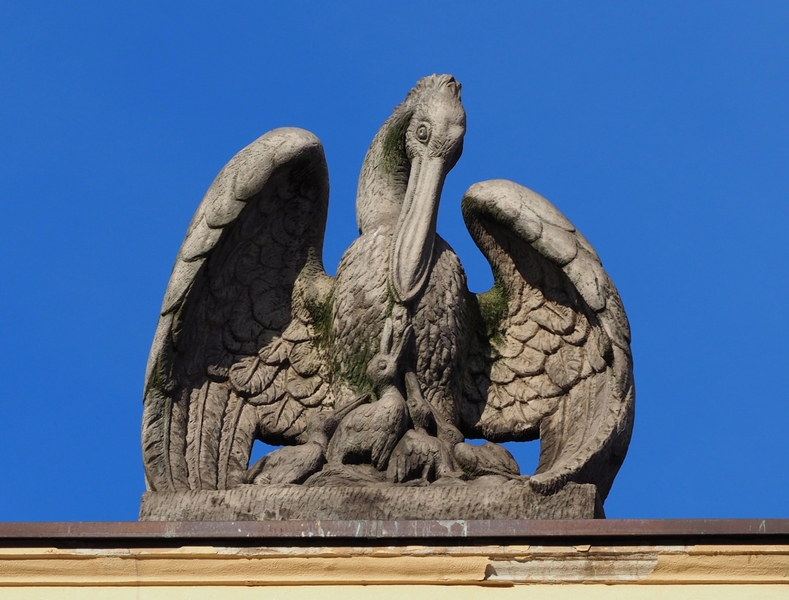
White eagles were everywhere, but I appreciated the bociany, the storks beloved by Poles like my late mother. I passed this one every time I went to get my pierogi at a recommended place on Bednarska. She seemed happy with her brood sitting on the roof of a bookshop on the Krakowskie Przedmieście.
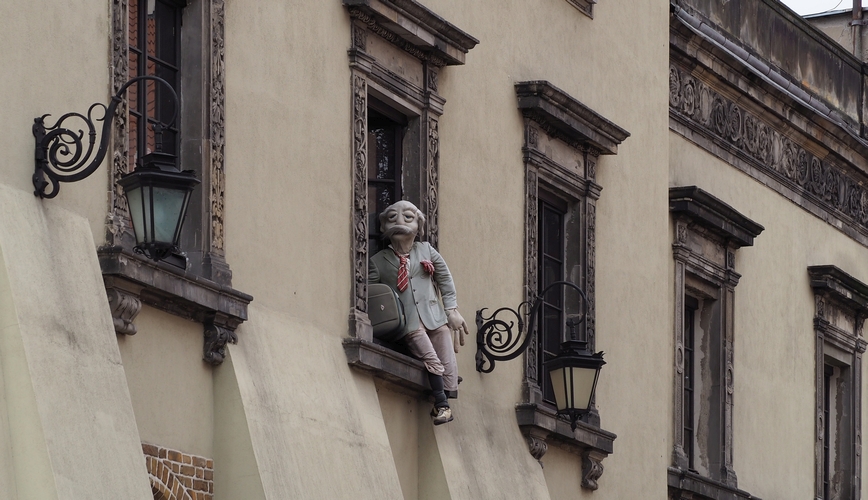
The Varsovians’ serious appreciation of history, recent and centuries old, paralleled their sense of humour. An inn opposite the Royal Castle had this old man trying to make his getaway without paying.
I mastered the Metro—I had to, to get to a Polish friend who accompanied me to the National Library—but not the bus system. I feared getting on the wrong one. Not all my destinations were as far away as the Warsaw Uprising museum. My pocket-guide map told me, among many other things, that Marie Skłodowska Curie was born in the building housing her museum on Freta Street, a few minutes from Podwale.
I loved my time in Warsaw, and the last few days with my cousin Celina from Puck were special. I don’t know whether I would have been able to catch the train north if it had not been for her. When she said be ready to change platforms at any time, I knew that the protocols at the main Warsaw railway station were beyond me.
The last morning i n Warsaw, Celina insisted on popping around the corner for a quick bite at her favourite Warsaw takeaway. She led me to the very restaurant I had heard about on my first afternoon. The setting was stark, but the food was delicious.
What had I been doing walking to the pierogi place on Bednarska all this time?

—Barbara Scrivens
31 August 2021
_______________
Michael Jarka’s piece on 1980s Poland is available at: https://polishhistorynewzealand.org/visiting-poland-under-martial-law/
_______________
If you would like to comment on this post, or any other story, please email editor@polishhistorynewzealand.org/
Taranaki’s First Polish Families
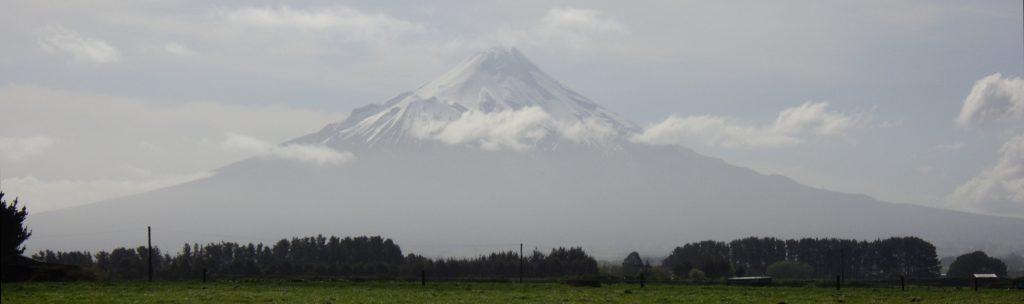
For years, a general story on Taranaki’s early Polish history seemed as impenetrable to me as the bush on the lower slopes of its mountain in the 1870s.
Descendants of the first Polish Taranaki families, when explaining their interwoven connections, inevitably ended with: “It’s complicated.”
The first Poles in Taranaki arrived off the Fritz Reuter, which carried more than 500 continental Europeans from Hamburg to Wellington in August 1876. The 260 or so Poles among them embarked in groups with other family or friends, and at first tended to stay in those groups. During their push for immigrants in the 1870s, the New Zealand government suddenly stopped accepting people from continental Europe. It apparently did not expect the Fritz Reuter’s arrival, and spent several months finding places to send them—away from the main centres.
The administration funnelled English-speaking settlers to more prosperous areas of the colony, like Otago with its goldfields, Canterbury, and Auckland. The non-English-speakers went inland to the Halcombe area, and settlements like Foxton, Whanganui, Hokitika, and Taranaki. The latter had developed a reputation for instability, thanks to the 1860s Taranaki Wars, which simmered with residual tensions between the colonisers and Maori who had had their land illegally confiscated.
The immigration barracks on Marsland Hill in New Plymouth accepted 52 of the Fritz Reuter passengers, among the first to leave Wellington’s stretched accommodation in mid-August. Of the 30 Poles among them, 27 walked out towards Inglewood in early September. Taranaki did not seem to receive the same funding as other centres. New Plymouth’s harbour was only finished in 1886, which prevented large ships docking, and allowed officials in ports such as Wellington to lure away many English-speaking labourers.
This worked in favour of the Taranaki Poles, because it allowed them to make a space for themselves, and later they were able to buy “waste” land—sections of that dense bush— at cheaper prices. The land carried a huge cost in labour, felling, stumping and clearing, but the Poles were patient, and cherished the stability that came with owning their own farms.
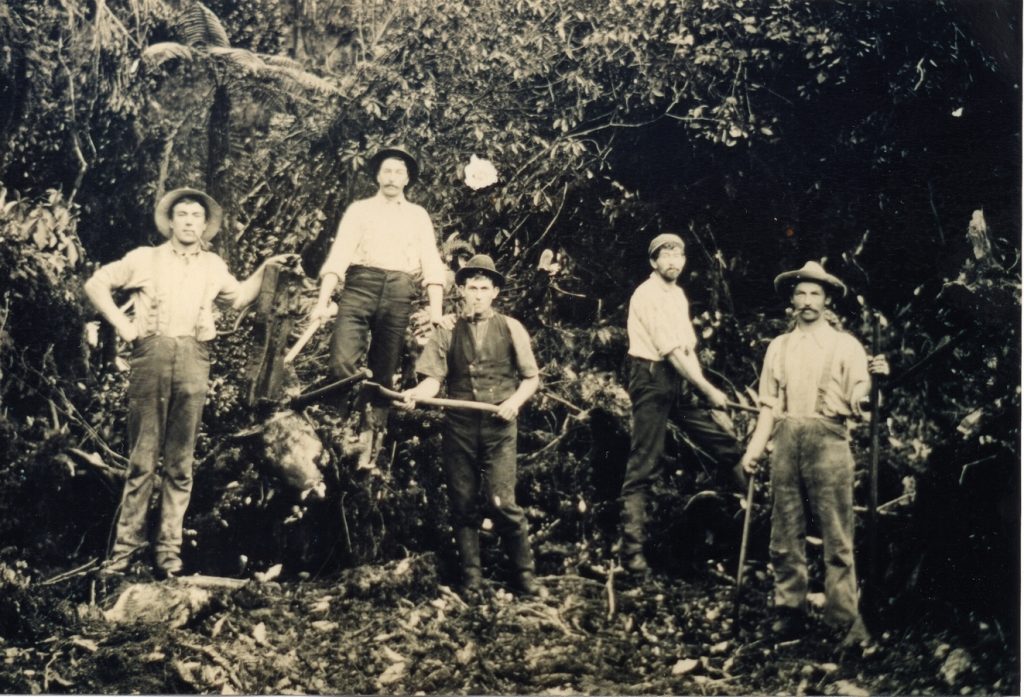
“Dense” is the descriptor attached most often to the bush that the first Poles walked towards in 1876, and this photograph shows just how dense it was. The many large trees sheltered a rampant undergrowth, still giving work to the settlers in the early 1900s, when this photograph was taken. The man on the left has been identified as Ben Dombrowski and the one in the middle as Paul Neustrowski.
During the late 1800s and early 1900s, Taranaki became home to the largest group of early Polish settlers, to the extent that young Polish men in other Polish settlements visited friends in Taranaki to become acquainted with its young Polish ladies.
Within a few generations, the original families, their married sisters and brothers with different surnames, marriages, births, deaths, and remarriages created a genealogical mass of relationships. I thought of it as a tightly packed ball of coloured threads of different thicknesses. Some families had helped me loosen some of the threads, but the ball remained largely intact, until I re-read a newspaper clipping celebrating 150 years since the first arrival of Devon and Cornish settlers in New Plymouth in 1841 that also mentioned Polish families receiving rations at Marsland Hill.
The clipping was among a growing number of files on Taranaki that sit on my shelves, with copies I had taken of the late Florinda Lambert’s transcriptions of news snippets from various Taranaki newspapers. She spent 14 years researching, and whenever I visited Taranaki, I made sure I spent a few days with the set of books she left to Puke Ariki.
Working on various early Polish family stories helped me understand more about their unstinting work ethic, their tenacity, and their pride in preserving their customs. That drew me to investigate and write about the Fritz Reuter in 2018. I tried to untangle why the New Zealand government, which so needed labourers, became so biased against continental Europeans. I called that piece The Human By-catch in a Colonial Immigration Industry because the people, the sentient beings who struggled to get here in 1876, were treated in such an unwelcome way—to the extent that the Fritz Reuter passengers are still not recorded on official immigration records.
Polish genealogist Ray Watembach and I examined the Marsland Hill immigration barracks ration book at Puke Ariki a year later. His Neustrowski great-grandparents, grandmother and grand-uncle were among those listed.
The large accounting book, divided by months, gave the names of exactly who had been in the buildings, and on what days. Eight of those names—Biesiek, Dodunski, Dusienski, Myszewski, Neustrowski, Potroz, Uhlenberg, and Volzke—became the core of the latest story in our Early Settlers page: Under the Mountain; Layers in the Mille-Feuille of Taranaki History.
The 150th anniversary article uncovered by Florinda Lambert shows the writer knew what they faced:
“Those who arrived in Taranaki in the 1870s or 1880s may have been able to step ashore at the foot of Mount Eliot [Marsland Hill] and walk only a few metres to find the comforts and services of a fairly substantial town, but once they turned their backs on those comforts and headed off into the virgin bush, they were as much on their own as any pioneers could expect to be.”
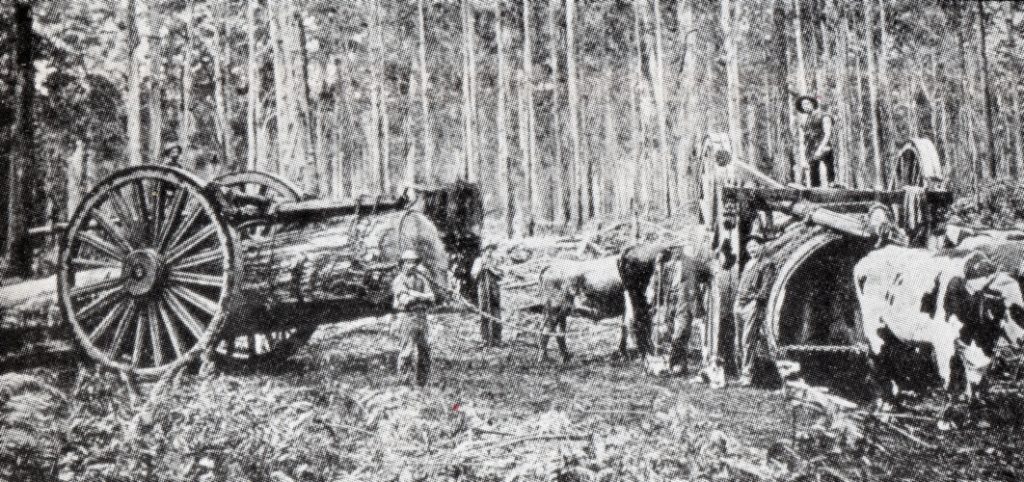
RW Brown captioned this photograph—in his book Te Moa, 100 Years of Inglewood History, 1875–1975—“Logging junkers in the bush.” It shows the engineering ingenuity used to drag the massive logs out of the bush, and the girth of those logs.
By 1879, Taranaki accepted Poles leaving “special settlements” along the West Coast, such as Jackson’s Bay, which imploded through under-funding and mismanagement. Taranaki needed as many willing labourers as it could get, and they soon joined other settlers in the bush. Although the Poles had been in New Zealand for several years, they started from scratch.
The Bielski, Bielawski, Crofskey (Kurowski), Lehrke, Stieller, and Zimmerman families arrived from Jackson’s Bay, and the Chabowski, Drzewicki, Fabish, Jakubowski, Kuklinski, Lewandowski, Meller, Rogucki, and Stachurski families from Hokitika, where many Polish families stayed after refusing to land at Jackson’s Bay.
Naturalisation records in 1918 included other Polish families, such as Dombroski, Drozdowski (Szczodrowski), Dudek, Dunik, Dusienski, Kowalewski, Pioch, Piontkowski, Schroeder, and Voitrekowsky (Woiciechowski).
These days, much of that impenetrable bush has been tamed, but I have the feeling that, while the Taranaki Polish family ball of interwoven relationships may continue to loosen a few of its threads, it will keep many close to its heart.
—Barbara Scrivens
29 June 2021
_______________
The Taranaki story is available at: https://polishhistorynewzealand.org/under-the-mountain/
The story on the Fritz Reuter is available at: https://polishhistorynewzealand.org/fritz-reuter/
_______________
If you would like to comment on this post, or any other story, please email editor@polishhistorynewzealand.org.
Condensing History
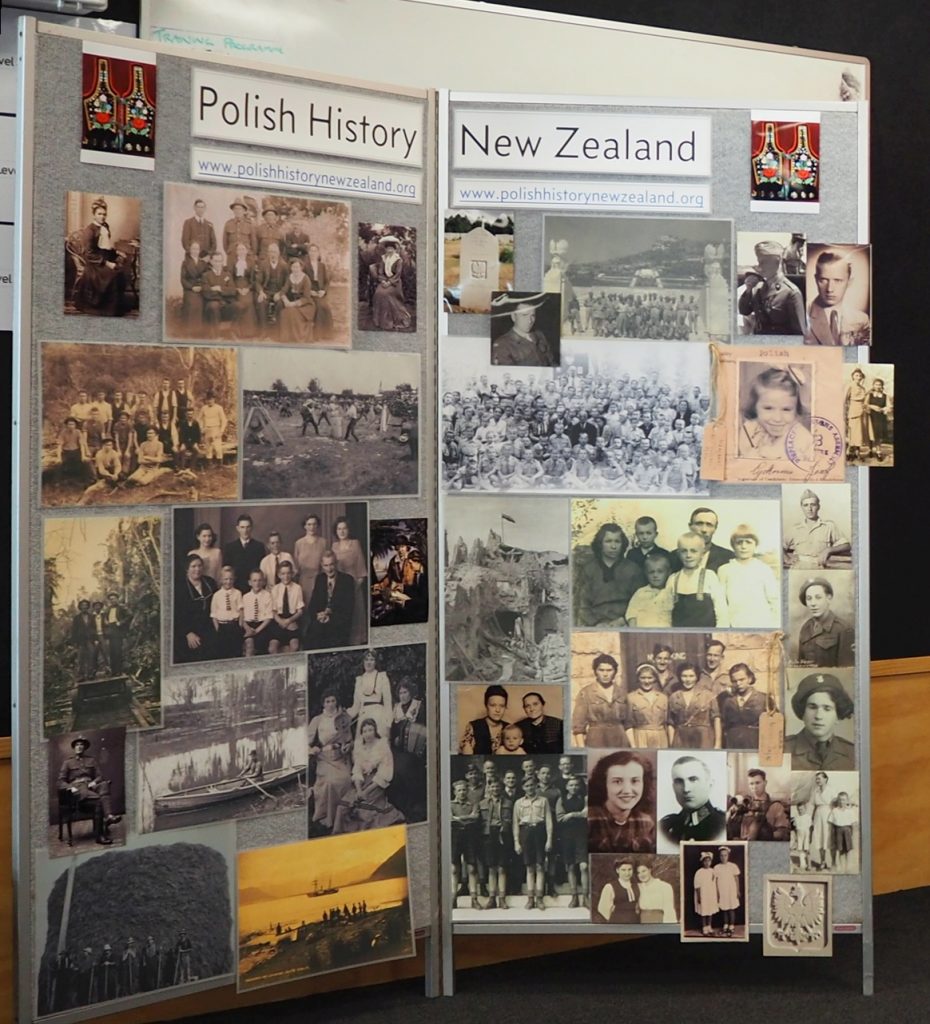
Teenaged Zosia Kowal made my day at the Polish festival in Wellington last Sunday. She stood next to her dad as we were chatting about the photographs in the collage I made for the event, and she surprised me with her curiosity and interest.
One 1914 family photograph showed August and Apolonia Neustrowski with their eight adult children, obviously taken to commemorate the two young men in military uniform. I told dad and daughter that even though the men of Polish families who had arrived in New Zealand in the 1870s, fought in WWI, their parents and siblings not born in New Zealand were classified as “enemy aliens” who had to report weekly to the police station, and had to carry a permit to travel more than 20 miles. This, despite the parents being well into their 60s, living in New Zealand for 40 years, and being naturalised.
Zosia’s shocked face: “I didn’t know.”
And why should she know? She had not been taught that history. She is in the majority. Her father, Polish Ambassador Grzegorz Kowal, did not know either.
I know that I only scratched the surface of New Zealand’s Polish history with them, but the photographs of Polish bushmen and a chopping competition also begged for explanation. I told them about the Polish man who started photographing the final moments of wood-chopping competitions—after too many judges made contentious decisions against Polish winners. Sons of the early Polish settlers who bought land covered in dense bush inevitably developed into experienced axemen.
The left side of my collage-stand reflected stories about early settlers, the right about the Poles who arrived here in November 1944, and after eastern Poland, post-WW2, was given—by her alleged allies Britain and the USA—to Stalin’s USSR.
I wondered which of my grandfathers died the ‘better’ death. My mother’s 34-year-old father was killed in action in northern France in September 1944. He left her mother with three surviving children, but died believing he had been fighting with the allies “For Our Freedom And Yours.” Much sadder, to me, was my paternal grandfather, who died knowing Poland had been betrayed by those allies.
He was 47 and with the Second Polish Corps when they captured Monte Cassino in May 1944. He survived that battle, and others in Italy, and at war’s end, remained in Italy with other Polish soldiers who refused to return to a communist-controlled Poland. Like him, most had lost their land in eastern Poland. In July 1946, his wife and two sons were in Africa, my father was in Egypt, a daughter and son were in communist-controlled Poland, and he was working with other Polish veterans in an office in Civitanova. I hope the water was warm when he had his last swim in the Adriatic Sea, and that he did not suffer too much when he had a heart attack, and drowned.
I had no swanky banners or touch-screens last Sunday, but the photographs in the collage told their thousand stories. Władysław Błażków gave me the one of him and his mates at the Polish cemetery at Monte Cassino, so I put him on one side of it, and General Władysław Sikorski on the other. The general was smelling a flower given to him after a parade during his last trip to Egypt in 1943, days before he died in a suspicious aircrash off the coast of Gibraltar. That image came from Pani Ula Poczwa, who I put with her sister, Celina, lower down, between images from the Zioło siblings of Christchurch.
Tadeusz Zioło gave me the photograph of him and six other Pahiatua boys posted to the Maritz Brothers’ High School in Greymouth, where they were sat at the back of a classroom and ignored. To their teacher, they didn’t exist, Pan Tadeusz told me in 2019.
Quite a few people tried to find a familiar face in the largest photograph of about 100 boys—one holding a dog—with their caregivers at an Isfahan orphanage. As my mother said about a photograph of her and other girls in an orphanage, “Look how happy we are.” Smiles are rare, although in the Isfahan photograph I used, there are some cheeky ones. Most of the children, and adults, look straight ahead. Below that was one taken at one of the hundreds of forced-labour facilities in the USSR—the Zatorski family in Archangielsk. It came from Pani Anna née Zatorska Piotrkowska, so I had to put her late husband, veteran Władysław Piotrkowski next to her.
Pani Zenona Pąk’s identity photograph with the stamp: Displaced Persons Assembly was a joyous counterbalance to the sadness of DP Pani Janina Iwanica, her mother and son in their IRO photograph, and the studio formality of the other soldiers, and Katyń victims. Pani Zenona’s five-year-old smile hid her traumatic life in the cold DP facilities in Germany’s post-war British Zone. Above her ID photograph is her nationality: Polish. Staples stab her hair-ribbon and shoulder.
Next to the smiling girl was a cut-out copy of the name tag that a Mrs T Campbell of No. 3 Line, Wanganui, kept for Kazik Zając. The Pahiatua children carried such tags around their necks when they took trains to spend holidays with New Zealand families, usually but not always with Polish heritage. Kazik, who arrived in New Zealand not yet six and not knowing the full names of his parents, was lucky. That loving Campbell family “more or less adopted” him, guided him through his boyhood and adolescence, and supported his love for flying. That’s teenaged Kazik below the group of Polish women at RAF Eastleigh in Mombasa, Kenya, and the other side of his old tag. He’s in a motor mechanics workshop.
I could not resist adding the headstone of A Soldier of the 1939-1945 War – Polish Forces – Known Unto God who lies with my maternal grandfather and 17 other Polish soldiers at the Canadian War Cemetery in Leubringen, south of Calais, or of my paternal babcia, aged 40, with my uncles at the civilian tent-camp in Teheran. Mainly because it is her angel who has pushed me to continue this website. She argued with Soviet soldiers who wanted to take her hogs in 1939, and I honour her bravery.
On the early settler’s side, I met only four of the people in the photographs—the ones in the 1950s Kuklinski studio shot. I chose it because that family was the epitome of Polish warmth, hospitality, and graciousness, descendants of the Kuklinski, Drewicki and Fabish families who arrived on the Fritz Reuter in 1876. (My babcia would have loved them.) To me, it is the perfect family photograph: a gentle mum and dad, sophisticated older sisters, and brother, and four imps. I loved interviewing Benna and Gertie Kuklinski, and their brothers Joe and Patrick.
When I was invited to take a table at the Polish festival in Wellington, I said yes because I thought I had to sort out only a laptop and large monitor. Irena Lowe then included two screens in the offer, and I bless her for that, because my hunt for suitable photographs reminded me of the amazing people I have met since I started this website in 2012. There have been so many, I could replicate this collage a dozen times and still not use the same photograph twice. What Sunday’s Polish festival showed me was that the hundreds and hundreds of hours producing this website over the past nearly 10 years have been well worth it.
Bless you all who are like me, pieces from the jigsaw of Polish history lucky enough to land in New Zealand.
—Barbara Scrivens
7 May 2021
_______________
There are too many story links to list, but you will find them all if you hit the Return to Home Page button.
_______________
If you would like to comment on this post, or any other story, please email editor@polishhistorynewzealand.org.
Rough Roads
Persians called the Kopet Dag mountain range “Bad Mountain.” Turkmens on the other side of the border called it “God Bless You.”
In the second half of 1943, the jagged range became the escape route out of the USSR for the last 300 Polish orphans left in an Ashgabat orphanage in then Turkmen SSR. Today’s satellite imagery shows the only road through the mountains from Ashgabat to Bājgirān on the Iranian side is still a winding monster. Those who did the trip nearly 80 years ago talk of dusty roads, wrecks in valleys, and alcohol giving drivers courage. Locals knew its danger lay in the cold and wind.
Most of the Poles who escaped the USSR with the Polish army in 1942 passed through Ashgabat by rail, and went on to Turkmenbashi on the Caspian Sea. That the Polish army favoured the 500-kilometre rail route from Ashgabat, through the desert to the sea port, rather than the 60-kilometre precipitous track to then-Persia, suggests they, too, respected Kopet Dag. Or perhaps the trains, and subsequent sea voyage, were quicker in the long run—and safer.
It is not clear when Jadwiga née Jarka Cooper and her younger brother, Jan, arrived at the orphanage in Ashgabat. In the latter half of 1941, their stepmother had placed them in the care of an orphanage in Pavlodar, northeast Khazakhstan, 4,000 kilometres away. Like the Jarkas, the Polish children left in Ashgabat were true orphans. Some arrived with older siblings, but without adult help, they could not have escaped the USSR.
Jadwiga—now in her nineties—recalled during an interview with filmmaker Warren Elliot at which I was able to sit in, that the Russians arrested the orphanage’s manager and caregivers. We will never know what happened to them, or what plans the Russians had for the Polish children, but a Mr Orlowski apparently evaded capture, and taught the older children how to cook and wash in bulk, and organised concerts to keep the younger children occupied.
Jadwiga remembered a “man from Ashkhabad.” He and Mr Orlowski may have been the same person.
“The man from Ashkhabad kept going to the office, to try and get us away. He kept begging the Russians to let us go ‘and there will be no more.’
“We were in groups, guides looked after the girls, scouts looked after the boys. We had the password for the gate. Finally, he came in the middle of the night and woke us up. Everybody was ready. The trucks came and took us. We were crying, praying, singing, because we were leaving Ashkhabad.”
Jadwiga and Jan made the trip in September 1943, a full year after Stalin closed his USSR borders to Poles trapped within them. How did the organisers manage to help 300 Polish children slip away? Their password for the gate indicates they followed a plan. Leaving in the dark strongly suggests the need to avoid detection, but there had to have been people left behind who put themselves in danger with the Russian authorities.
The last children arrived in Isfahan in December 1943. September in Ashgabat sits outside the snow season, with temperatures between 16 and 32 degrees centigrade, but the December trip must have been harrowing—winter temperatures range from to between one and 10 degrees. Whoever organised the children’s multiple trips over the Bad Mountain must have known it well.
Pani Jadzia chatted with me for hours in 2016, about her early life in Poland, about her family, about her father—an officer executed in a west-Russian prison by the Soviet NKVD in 1940—and about getting to New Zealand, and living in Pahiatua. She told me that recalling her life drained her emotionally for days afterwards, so I did not push her further than she wanted to go. Her original story was already enough, many times over. I divided it into two, A Shoebox of Ribbons and New Zealand, Land of Everything (except bird milk).
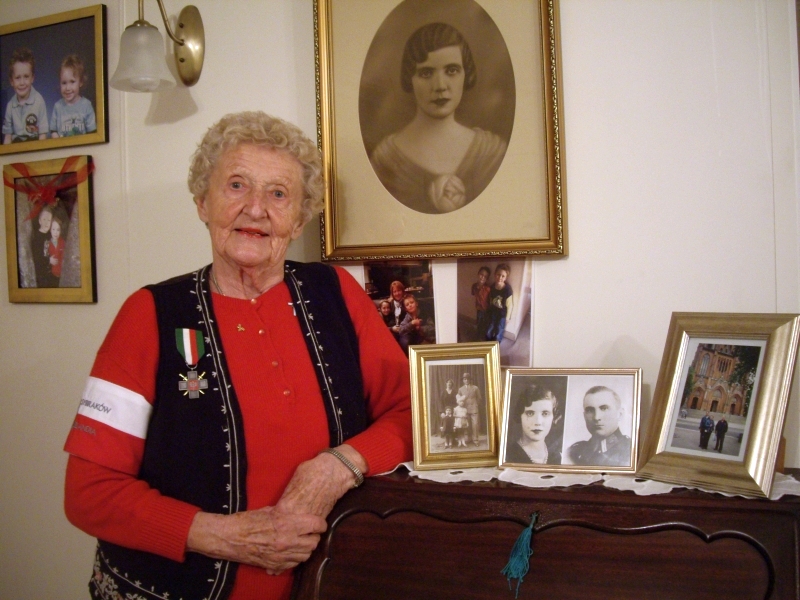
Listening to her again five years later, shows me that age does not diminish the starkest memories, and that there will always be gaps to be filled. I have updated Shoebox. How could I not, after hearing, among other things:
“It was a very winding dirt road, so the drivers had to have a little alcohol. Our driver took a wrong turning in the dust and had to reverse. As he was going backwards, I saw the precipice and screamed. The caregiver threw a blanket on me to stop me upsetting the younger children in the front of the bus.”
On the days that Kopet Dag received the Polish children in 1943, anyone would have agreed that God did indeed bless those Polish children.
—Barbara Scrivens
30 April 2021
_______________
Pani Jadzia’s stories can be found at: https://polishhistorynewzealand.org/jadwiga-jarka-cooper/
Pani Jadzia used the old name for Ashkhabad, now Ashgabat.
Information about the Kopet Dag range came from: https://en.wikipedia.org/wiki/Kopet_Dag
Krystyna Skwarko named Mr Orlowski in section 15 of her book, The Invited.
_______________
If you would like to comment on this post, or any other story, please email editor@polishhistorynewzealand.org.
Foreigner
Whoever invented the word “babble” had it right. In the slow traffic this morning on the way to school and daycare, I tried to explain to my grandsons what it was like not understanding a word anyone said.
We were talking about “tricky words” in English—the older one is learning to read—and I said that that every language had its tricky words, but they were at the perfect ages to learn them, like I had to when I started school in England without a word of English. Quiet, then:
“Didn’t anyone talk to you, babcia?”
“Even if they did, I didn’t know what they were saying.”
“Did you talk to anyone?”
“Even if I did, they wouldn’t have understood me. What I do remember is standing in the playground, turning slowly around, and hearing, ‘Bab bab bab baba blah bab bab…’” I babbled in staccato.
“That’s not a real language,” from the younger grandson.
“No, but that’s what it sounded like to me.”
I told them how, when they heard my mother call me “Basiu,” some of them started to call me “Bash you! Bash you!”
“That’s not kind,” from the older grandson.
“No, but I learnt say, “I’ll bash you in a minute!”
They were quiet for a bit, and then we turned down the school road.
_______________
I’m not sure how I learnt that phrase. Possibly my mother had overheard. What I do know is that it must have been tough to get a rise out of someone who did not respond to the general babble.
“Foreigner” was one of the words I learnt. I remember the subject coming up in class, when I was about nine, by a new teacher from “up north” who struggled to understand our southern accents, and who talked about feeling like a foreigner in Dunstable. Suddenly I knew why I was called this name—I was born in St Albans, Hertfordshire, about 30 miles away.
My childhood confusion about heritage is exactly why I talk to my grandsons. I want them to know their Polish links, to get them to think, to give them information that will help them draw their own conclusions about humanity, and its inherent prejudice and bigotry.
My parents, grandmothers and four uncles were WW2 refugees, something I did not fully grasp until I started to research my family. I had got used to being different, an outsider, but when I married an Englishman, it was so much easier having his surname.
I had two good friends in Dunstable: Linda and Pauline. They didn’t seem to get on, but I lived near Linda, and Pauline used to invite me to her family farm on Tring Road, under the Dunstable Downs and near the Dunstable Gliding Club. I loved the way Pauline’s dad was so kind to me. I did not realise he had the same accent as my parents—their surname was Kaye—or that he was the man in the white van who used to stop on the corner of our road and sell my parents the most delicious kiełbasa and wędlina. He married an Englishwoman who insisted he change his name to something that would not disadvantage his children in a post-war England. Pauline, half Polish, never had to experience an ignored raised hand for an entire sewing class, or had to resort to walking behind her teacher as she walked between the rows of desks. That was a mistake I did not repeat. She scolded me, then told me to unpick the hem on my apron because I had sewn it the ‘wrong’ way—left to right instead of right to left.
_______________
I’ve emigrated twice. First, as an 11-year-old when my father was offered a job in South Africa. Second when my husband and I and our two children moved to New Zealand. I know how tough it is to start again in an unfamiliar country, and have a particular sympathy, an empathy, with Poles in New Zealand.
All peoples here are immigrants—Europeans, the newest, a result of forceful colonisation. The British colonisers’ automatic assumption of the moral high ground became clear to me shortly after I started scouring through early newspapers and parliamentary papers digitised by our national library.
I appreciate being able to remotely access Papers Past. It allows researchers like me to step into the lives of people living in New Zealand when newspapers were key communicators. It lays bare the prejudice that non-British subjects endured.
I recently searched the surname Biesiek, one of the first eight Polish families to Taranaki in 1876. Paul and Marianna Biesiek joined thousands of others who emigrated from the oppressive and increasingly germanised Prussian-partitioned Poland, where their language and religion were banned, and where they barely made a living. Their 18-month-old daughter died at sea, but they had at least two more sons in Stratford, Joseph, and Thomas.
I discovered that Joseph, then a dairy farmer from Ratapiko, had been among several “local boys” called up for military service in January 1917.
Both appeared in an 1918 article in the Taranaki Herald under the heading A Question of Parentage. It illustrated the depth of the New Zealand government’s distrust of Polish heritage. Joseph Biesek, “after being trained… had been turned out of camp some 12 months ago on account of his parentage…” Joseph did not take his turning out lightly, because “as the outcome of his continued representation to Sir James Allen he had again been ordered to camp.”
Sons of the early Polish settlers in New Zealand fought, died, and returned wounded after WWI, yet before they left, and after, the government classified their parents as “enemy aliens”—even those who had been naturalised years prior. They received notice in 1916 that they had to report weekly to a police station, and not travel without a police permit farther than a 20-mile radius.
In 1916, the Taranaki Poles made a “strong protest” to their MPs about their enemy alien status, and were placated, temporarily. In 1920, they were again humiliated when the validity of their votes was questioned in the 1919 election in the tight Stratford seat, and they had to defend their characters in court.
_______________
In early adulthood, I heard the words “get over it” often enough to suppress my railing against what happened to my family and other Poles during and post-WW2. I am grateful that I now can use my chisel to dislodge some of the egregious behaviours that Poles have had to deal with for so many years.
I appreciate digitisation for making it so much easier to inspect the documents of the past, primary sources without sanitisation or distortion. My experiences growing up have made me sensitive to the historic slurs of Poles, but it is a relief to know that those experiences had everything to do with my surname and my parents’ accents and nothing to do with me.
The next time we have the boys over, I will answer the question I couldn’t yesterday: a spider in Polish is a pająk.
—Barbara Scrivens
31 March 2021
_______________
Papers Past and the appendices to the Journals of the House of Representatives are available by typing Papers Past or AtoJs in your search engine.
_______________
If you would like to comment on this post, or any other story, please email editor@polishhistorynewzealand.org.
Creating Context
This morning on RNZ’s First Up, I heard an interview with a woman who is systematically cleaning up the graves and headstones at the Matakana cemetery. She does not stop at clearing the sites and rejuvenating the marble and stone, she researches what she calls the “essence” of that person, and writes a vignette about them.
She is in complete contrast to another woman I happened to get into conversation with today, who believes the past is behind us, and should stay there. Her implied question: Why am I wasting my time with Polish history?
In a way, she had a point. Dwelling in the past has the potential to become detrimental, but I believe, like the Matakana angel, that the stories of ordinary people have their own place in history. They give us perspective, a grounding in the reality of most human lives. History is so full of the escapades of kings, queens, political leaders, and military victors that it is difficult for the ordinary man, woman or child who lived under their rule, to be given a thought. Those kings, queens, political leaders, and military victors did not exist in a vacuum. They always had minions to wash, cook and carry after them, whether it was in the days when their horses had to be fed and brushed, and their stables cleaned, or today when they are supported by multi-varied taxpayers.
This month I have been delving into the stories behind the Polish families who appeared in the 1876 ration book from Marsland Hill immigration barracks in New Plymouth. They were among the last large group of Poles to immigrate here under the 1870 Public Works and Immigration Act and arrived among controversy at a time when the colonial government stopped assisted immigration from continental Europe.
With most of the Polish names tortured by various officials, I appreciate being able to use lists and search methods that allow spelling flexibility. I curse the rigidity of Internal Affairs, which, by not embracing wild card technology, continues to make it difficult to trawl for official births, deaths, and marriages. The permutations of Polish surnames are endless when also accounting for spelling mistakes. This is why we have included as many variations as we have found in our new search function for early Polish settlers.
The Myszewski family at Marsland Hill presented challenges: a man aged 41 with a 22-year-old wife, and what seemed like seven children. The ration books confirmed that at least two of the children’s ages had been mis-transcribed in some of the passenger lists. Lucia and Johanna were not toddlers of three and two, but young women of 24 and 19. They were not Jan Myszewski’s daughters, but they may have been his nieces.
According to the Pomeranian Genealogical Association, they were christened Lucianna and Joanna. Their parents were Mathias Myszewski and Katharina née Jendernalik. Mathias died aged 58 in 1868, and Katharina aged 65 in 1875. According to the PTG’s records, there had been six children in the family: Marianna, born in Pinczyn in 1847, and who died aged two; Lucianna, born in 1951 and, like the rest of her siblings, in Kokoszkowy; Paulina, born in 1853; Joanna born in 1856; and twins Adam and Eva born in 1860. Adam died aged three months and six days. I found no death records for Paulina or Eva to 1876, when Lucianna and Joanna stepped onto the Fritz Reuter, but there is a marriage record of a Paulina Myszewska marrying a Piotr Domachowski in 1876, so if Eva did live, one can build a picture of a married Paulina taking care of her younger sister. One can only surmise why the sisters left their home country. Despite the recent death of their widowed mother, it could not have been easy leaving their sisters.
For whatever reason, Lucianna and Joanna were outliers in what became one of the largest Polish families in Taranaki, known as Mischewski or Mischefski.
The sisters did not stay long at Marsland Hill. Single women were the most sought-after immigrant, and younger ones received free passage. The new colony inhaled them for their domestic and other comforting abilities, and their maiden names were often mangled to such an extent, that they disappeared. Joanna was “engaged” on 19 August 1876—the same day as her cousin Julianna—just three days after she entered the barracks, and Lucianna three days later.
The ration book does not give employers’ names or addresses.
Joanna proved easy to follow—at first. Her name appears at the top of a page of transcriptions of Catholic marriages in New Plymouth involving Poles. (Julianna’s is immediately below hers. She married fellow Fritz Reuter passenger Franciszek Uhlenberg.)
The names were spelt incorrectly, but it is clear who the bride and groom were: Johanna Miszrenska (21) married Anton Thondrowski (25) on 30 September 1876. Anton Szczodrowski had arrived in New Zealand on the Shakespeare seven months earlier, and was the widower of Julianna née Krakowska Szczodrowska, who died in childbirth during quarantining on Matui/ Soames Island. I wrote about her in the story Who’s Behind the Name?
That marriage transcription was the last place I could confirm Joanna’s whereabouts. With her married name having more possible computations than her married one, I have been unable to find anything more concrete about her, but wonder whether she could be the Johanna Schasowske who appeared, aged 58 in Hamilton, on New Zealand’s 1917 Alien record. Or whether she is the Johanna Schdroski who lies in Hamilton West cemetery, buried in August 1923.
Lucianna was more elusive at first and when I could find no trace of her, I feared she had died soon after arriving in Taranaki.
She left the immigration barracks the same day as Karl Schultz, his wife, Paulina, and their toddler daughter, the only ones to leave that day. I like to hope they were employed as a group, and that Lucianna was not alone.
Genealogy researcher Paul Klemick added some bricks to her wall of life: Lucianna became known as Lucy, Luccia and Lusi. She was definitely in Sydney on 1 October 1884, because she married Alexander Leis that day. She and Alexander settled in Quirindi and had three sons, in 1890, 1892 and 1894, the first and third dying as infants. Alexander died in 1904. According to the 1913 Quirindi electoral roll, she was then living with her son John Patrick. Although there are six other Leis surnames listed on the area’s 1936 electoral roll, John Patrick’s name is missing, and Lucy does not share an address with any of the others.
Lucy née Myszewski Leis died on 1 December 1940, just a week after her 89th birthday, and is buried at the Quirindi General cemetery.
I am with the woman caring for those who lie in the Matakana cemetery, and their graves. Even without fleshing out their lives, there is something satisfying about being able to give people a proper full stop.
—Barbara Scrivens
28 February 2021
_______________
The Fritz Reuter: The Human By-Catch in a Colonial Immigration Industry: https://polishhistorynewzealand.org/fritz-reuter/
Who’s Behind the Name: https://polishhistorynewzealand.org/whos-behind-the-name/
List of Early Polish Settlers: https://polishhistorynewzealand.org/list-of-early-polish-settlers/
_______________
If you would like to comment on this post, or any other story, please email editor@polishhistorynewzealand.org.